When I grow up (hahahaha!)
I want to be just like Inheritance Machining.
So if he chamfers all the things, then I must also.
More honestly, I've always broken the corners of machined things to some degree - you can't hardly help it since even a clean 90º angle can cut flesh. The amount of effort I've put into this depends a lot on the part or tool I am working on. Sometimes a few strokes of a file suffices, sometimes just running some nasty burrs under the deburring wheel.
When I make a thing, I like to break all the corners. I've faked it
with things like countersinks, which never have the right angle of 45º
because they are countersinks. But the results don't look as good or feel as
good to the hand.
Watching real craftsmen at work has has left me very dissatisfied with my deburring / chamfering game. I began watching out for chamfering tools of various sorts, especially something with inserts, because although there are plenty of solid carbide cutters around, I can't sharpen one if it gets dull, and I do plan to use this hypothetical tool extensively.
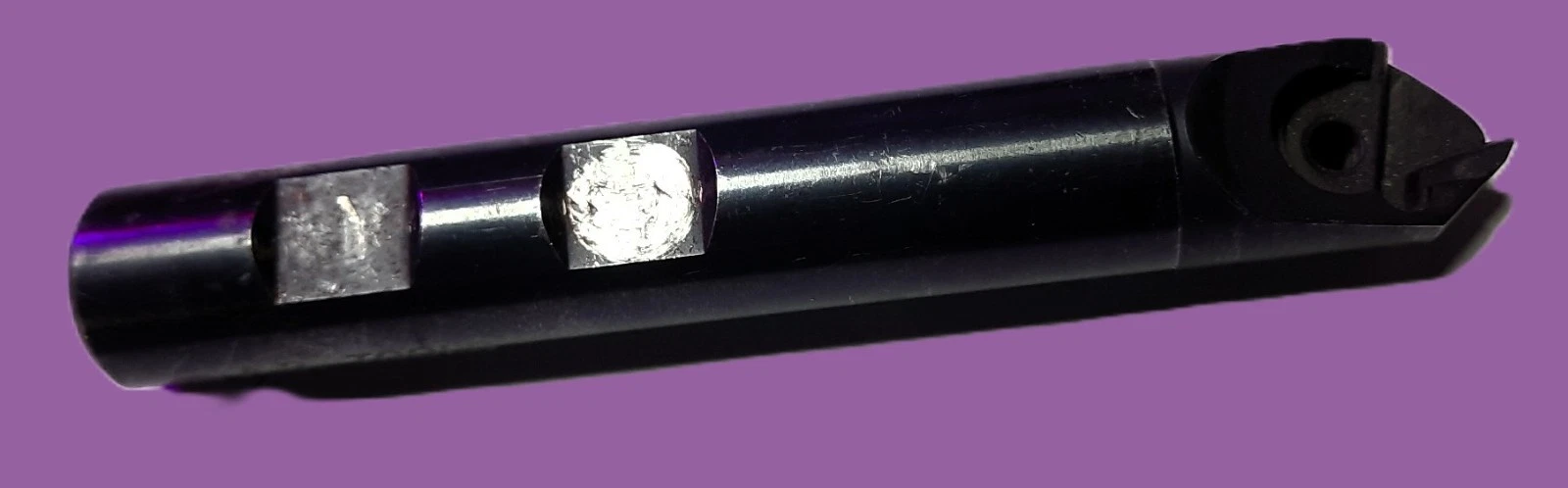
Right then, I may have just made a tooling purchase error, but I will remain optimistic until I've actually played with the thing. (it should be here in a few days)
 |
Part of the issue with making my own is I still don't have a way to do decent heat treating. I can barely manage to heat things with a propane torch (oxyfuel tanks are nearly empy so they can't be used) and dunk them in water, observing the nitride color bands. I've had mixed results.
So I've kept my eyes open for a long time for a milling insert holder with a 45º cut. Finally found one, cheap because it was missing the insert hold-down clamp. One could make one if one had to (again with the heat treating problem) but fortunately, this one is still available - I haven't called for the price yet - from the maker.

I was at first concerned that their catalog has this to say:
"This cutter was developed in 1982 for spot drilling and chamfer milling small slots
in non-ferrous part materials. If used prior to drilling in non-ferrous
materials it performs well. If used as a countersink after the hole is drilled it is
chatter prone."
(my note: AFAICT this is a consequence of their insert choice)
"It is not for use as a rotating cutter in ferrous materials since the (25 ) relief
angle is too weak."
Again, this refers to the inserts they provide. Other inserts exist, as this size and shape is extremely commonplace, and many, many geometries and coatings are available, different relief angles, different chip breakers, flat with no chip breaker, etc. Also, chattering is unlikely in my interrupted cut chamfering operations on the outsides of parts. Even so, I bet with the right insert geometry I can do holes without chattering too.
"However, in the more rigid lathe environment
it can be used successfully to spot drill holes in ferrous materials.
We spot drill our Accu-Holds (4340) in CNC lathes at 900 RPM and
.0005 IPR, with tool life of 200 holes per insert corner.
It should never be used in a drill press."
Well yes, and duh. :P One does not use an indexible single-edged carbide cutter in a floppy drill press, ever. I am imagining the stupid customer service calls which resulted in these warnings. My mill is reasonably rigid as turret / knee mills go.
Anyway, they are talking about drilled holes. I can imagine the inserts they sell would chatter in drill holes, even tho that's what they sell their damned tool for. But they are very focused on firearms, too, so they have weird viewpoints on tooling, they are not a generic tool supplier. Anyway, my mill is more rigid (I think, can I prove that? hmm!) than my lathe and much more rigid than the drill press, so I might squeak by, heh.
Hopefully the maker does not want too much for the insert clamp. $10 seems reasonable to me. $20 seems more likely. It's a tiny piece of curved steel the size of your thumb nail. OTOH, if they want $40 or more just because it's a $200 - $300 tool and they know it's useless without the clamp, then I'll tell them to fuck themselves and I will make my own clamp. Business office opens tomorrow, we'll see.
~≈{👁}≈~


 Posts
Posts


No comments:
Post a Comment