This was supposed to have been posted ages ago. I thought I had posted it. But I've searched the blog for various key phrases, and it seems I never posted it. If I did, and you're reading it twice, my apologies.
~≈{👁}≈~
When one wishes to poke a hole in something, of arbitrary size, and especially when it's bigger than any drill bit you have... there are ~~several~~ well, two, machining options and one sloppy option.
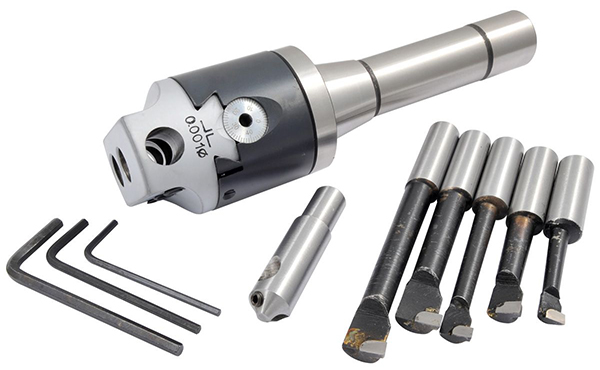 |
The tool shown offers one thou adjustment per screw graduation. |
Ze Boring Head
• Chinese units are expensive. Good ones are breathtakingly expensive.
• Large; the smallest I've seen (some rare beast Mr. Pete found), is about 1.5" in diameter (minimum hole size)
• Capable of very precise cut adjustment
• Convenient to use- once the tool is set up, increasing the depth of cut by a thou is a matter of turning a screw
• Lots of off-center mass, tries to shake/sway/bend your machine's column, so best used in a full sized knee mill or a VERY stiff, square-column bench mill. You will typically have to run at lower speeds than the SFM would normally allow
• Uses boring bars which usually have carbide inserts, some are just brazed - maybe you can sharpen it, but probably not.
• Best for deep holes like engine cylinders
Ze Fly Cutter

• So cheap they're nearly free. Seriously, HF practically gives them away as door prizes (nearly - a set of five might be on sale for $10), and because it's basically a hunk of funny-shaped steel which has no built-in need of precision, there's no need to shop for anything better. This is a tool fetishist saying this. Cheap ones work fine, it's the cutter you'll want to spend your time and money on. (cutters are almost never included)
• cutters can be made from inexpensive HSS square tool stock, which you grind to a cutting tip yourself - this is less convenient than carbide, but ever so much cheaper cost of ownership, and a very useful (some would say mandatory) metal shop skill to acquire. Use both ends of the tool stock.
You can also use cheap Chinese insert holders in these.
• "tool setting" - that is, setting a fly cutter's tool to a specific, precise diameter - is fiddly but you get used to it.
• readjusting depth of cut once you've set it is a simple matter of doing the tool-setting job all over again - wait, what? Yeah, that's a fiddly disadvantage. Did I mention they are cheap?
AFAIK, that's it for precise and semi-precise holes. The other large hole cutting options I can think of are not adjustable, and they make relatively imprecise holes.
If your hole is a nice common dimension and not say, "pi inches", you might find a shell mill cutter that will do the trick, provided the material is less than an inch or so thick. These are expensive. The cost of re-sharpening shell mills is nearly as much as buying a new one. Used ones on eBay tend to be dull. These are non-trivial to sharpen, it requires a "universal tool grinder" and knowledge/skill.
A third option, for making approximate holes - not cut to any tolerance at all, is ordinary hole saws.
They are cheap.
Good (AKA “bi-metal”) hole saws are quite capable of cutting steel, aluminum, brass, whatever, provided one:
• uses copious amounts of a good-quality cutting fluid*
• backs off the cutter frequently; lets fluid back into the hole, allowing teeth tips to cool a bit
• uses low cutting force - if you tend to burn up drill bits, this method is not for you
I have a few garden-variety, hardware-store hole saws that have seen _extensive_ use, including cutting lots of circles out of .25 and .5in steel plate,
and they are still sharp. Done right, this method is _messy_. It can be less messy if you’re willing to burn up your hole saw halfway through cutting a hole, but I recommend letting it be messy.
On numerous occasions I have rough cut a hole with a hole saw, then cleaned it up and dimensioned it with a carefully-set fly cutter. i should probably do an entry about how to do that, although there is probably one on YouTube already. I'll look and maybe link it.
~≈{👁}≈~
_____
* ie; preferably _not_ the stuff sold in the hardware dept for threading pipe - that’s the Lowest Common Denominator of cutting fluids; it works for carbon steel only, its high sulfur content stains copper and brass, it does you no good with copper, soft aluminum or stainless…
personally I'm not a fan.
I prefer Tap Magic™(standard grade). It is expensive but I brush it on by hand so I only use a quart every year or two. There are plenty of other good productss.
Just use _something_. The thing about the high performance fluids like Tap Magic is that they make difficult-to-machine materials like copper, 300 series stainless, and (gods-help-you) titanium, much easier to machine, with a cooler running
tool, better chip breaking, and better surface finishes because little or no Built-Up Edge. High-sulfur cutting oil from the
plumbing department does nothing for these materials. And plumbers don’t much care about the surface finish of
their pipe threads either - you might. ;)


 Posts
Posts


No comments:
Post a Comment