Showing posts with label general news. Show all posts

Saturday, September 26, 2020

recovery mode

 I have obtained part-time work at my previous "emergency" job; my old boss was happy to have me back, and was able to offer me a substantial raise over what I was making there the last time. Not as much as I was making at the job I was just fired from tho, and no insurance to speak of...

 Meanwhile, I already have a contact about a Deployment Engineer in the NOC (but remote - I can do it from home) of a Seattle gaming company... but it's not clear to me that I'm qualified, this is just an initial introduction...

 My next post should be the long-awaited wrap-up / summary of everything I learned from my recent experience adopting industrial hot glue guns and glue sticks for home shop / hobby / craftsman purposes.

Friday, September 4, 2020

Is ACME now a DoD vendor?

 Apparently we've taken to dropping anvils with knives strapped to them on the heads of villains.  While this sounds ludicrous, it turns out to be highly effective when it lands at several hundred miles per hour.

 I'm not making this up.  It's not even the spookiest precision guided weapon we've got in the field right now either.

I dislike my fellow man today. 

I'm going back to bed.

Monday, August 17, 2020

short-wave radio, tattoos, and guns

 While I was employed at one of my many jobs in Boulder (a smaller college-centered city about forty-five minutes northwest of Denver) a co-worker who was in the Boulder Amateur Radio Club, having discovered that I was into amateur radio also, suggested I go to their (weekly? monthly? I forget) lunch gathering.

 So I went a few times, and I got to know this interesting and very old (and very pleasant, soft-spoken, smart, vibrant, and terribly wrinkled and weathered-looking) Jewish couple.  This was nearly twenty years ago, I expect they are gone now, and a good thing, too.

 This couple were avid radio enthusiasts. They were into long-distance HF contacts, and not many of the other possible aspects of being a "ham".

 They were also very into guns and shooting, which surprised me.  Honestly, they both looked so frail, short, and thin to me, that I thought the recoil of most firearms would break bones.  Which just goes to show you that not all old people are frail and weak... or defenseless.

 But it all clicked on the third luncheon or so, when I spotted the fuzzy, faded, blue numbers tattooed on the insides of both forearms.  Very old.  Jewish.  Into guns and long-distance communications which are nearly impossible to block or interfere with or even locate.  Huh.

 They had been in - and survived - the camps in Germany during WW-II.

 And they had no intentions of ever entering one again.  We never talked about that.  Why would anyone ever bring it up?  You already know everything there is to talk about.

I am so glad they didn't survive to see their adopted home descend to what it is today.

Sunday, August 16, 2020

where's Kevin Kostner when you need him?

 Regarding that elusive milling cutter which is allegedly on its way to me... it turns out that SpeedPak*, the carrier service used to ship my cutter, hands off their shipments to... the United States Postal Service.

 Now, it really wasn't all that long ago when this would have been happy news indeed because for my entire life, since I was a child in the 1960s until just about two weeks ago, I knew I could rely upon the USPS to do a good job.

 But of course, thanks to our Fearless (Brainless) Leader, the speed and reliability of the US Postal Service is out the window.

 So naturally I doubled down instead of being cautious -- just like our president would!

  Yesterday I ordered, via eBay, a Noga style (Shars, in this case) dial indicator holder, like this one:


 This is the second indicator holder I've ever owned, and I bought the first one - even cheaper, a HF PoS, at Charlie's Second-Hand tools for nearly nothing. Before this month, I've gone without, or rather, I've made my own ways and means on the spot as needed. And it's been a pain in the ass, too.

 What makes this style of holder pleasant to use is that the one knob in the middle locks up all three joints.  So you have fastened the magnetic base to something, you can hold the indicator where you want it, use the knob to move the arms to a reasonable position, and then with a twist of that same knob, lock everything up. It's like having a third hand. Another convenience is a fine-adjustment built into the indicator holder, making setup a little easier.

 The other item I picked up is a simple bracket assembly...

 which lets me mount a cheap DRO, or Digital ReadOut, like this one...


 to the spindle feed of my Bridgeport mill, like this:


...sorta, except the above photos show a method which requires drilling a bunch of holes in the mill, whereas the Shars bracket mounts using the scale screws on the left, and tracks the movement of the quill by picking up that great big round hole in the front of the quill stop. Gotta love this guy's quill feed wheel tho... 

EDIT: I'd quite forgotten, but both these items came from the same seller, who shipped them via FedEx, and they are guaranteed to be delivered by the 20th. Huzzah!

__________________________________________________________________________
* a partnership between eBay.cn and OCL and the default shipping option for sellers in China

Tuesday, May 21, 2013

this isn't going to be easy...

Short version: I am "renouncing" all of my technical "mad science" hobbies, including anything involving high voltage, stored energy, high energy physics, etc.

I am already in the process of disposing of all the projects, parts, materials, and support equipment relating to same. I'll sell what I can, give away or throw away what I can't. Much of it is so large and heavy I would rather have it hauled away for scrap than deal with crates, skids, forklifts, flatbeds, or other heavy motor freight means.

This is not a joke, nor is it a decision I've made in haste. I have spent the first 50 years of my life completely scattered, unable to focus on or choose the things which matter to me most.

Now that I am on Ritalin (40 years too late, sigh) it has become quite a lot easier to prioritize -- to determine which hobbies I can do well, which ones are impractical to pursue, not to mention which pastimes will be the most gratifying.

I still have one or two hobbies remaining, but I desperately need fewer of them in toto.

As a result, this post could be the last I make to this blog, unless I feel a need to announce other unrelated future accomplishments to the world, such as semi-artistic creations. I would like to finish (and SELL) the "Mad Scientist's Light Switch", and I would like to finish the rolling ball sculpture I started a bunch of years ago.

I am hanging onto my shop and fabrication resources to use for the remaining hobbies.

I expect I'll just let this page sit here a while, and then eventually delete the blog completely.

Oh, and if you are or if you know anyone in the Denver / Front Range area in Colorado who is interested in high voltage, Tesla coils, railguns, pulsed power, etc, please put them in touch with me - I probably have something they want.

Monday, January 28, 2013

Tesla coil and "why so many projects?" also, "why don't you ever finish anything?"

1. Tesla coil
I am making headway on the Tesla coil, and have redoubled my efforts (in between trying to do real work for real money, about which more down below) because a friend is opening a very cool new art-nerd / techie arts & crafts type store in Denver, and very much wants to have an impressive Tesla coil at her grand opening in March, which is, um, roughly a month away. Oi. We'll see. I'm trying.

2. "Why do you have so many (unfinished) projects?"
I suffer from ADD - Attention Deficit Disorder, and have my entire life. It's been marginally worse since I had a protracted fever a few years ago. I now take Ritalin, and it has changed -- or I should say 'is changing' -- my life. Sadly, that's 45 years too late, but better late than never.

In the past, whenever I hit a snag in a project that I couldn't get around, I tended to find other things to occupy my hands while thinking about how I could get back to work on the other project, with the least added effort and expense. Quite often it's lack of an expensive part of material that holds me up. Whatever the reason that one, or two, or three projects are on hold, I need something to occupy my time.

Another reason for having multiple projects is simply that some of them are inter-related. I need a good working vacuum system (among other things) for several other, larger, experiments I'd like to do. The micro-Marx pulser is needed to trigger the experimental gas switch I've completed, but have not yet tested.

And while I have had a life-long tendency to take too long to finish projects, I am in fact finishing projects now that I am on the Ritalin. I have more perseverance and much more focus than ever I ever enjoyed before.

Unfortunately, having my job yanked out from under me due to a reorganization left me unable to pay for materials and parts. I also need to spend time looking for work AND trying to identify and reach my own customers for work that I can do with my own resources.

And finally, health problems of one sort or another continue to interfere with my ability to get things done.

All that said, more progress has been made on my various "mad science" / research / hobby projects in the last year than in the previous ten.

I've also been posting videos occasionally to my YouTube channel, which is HERE.

Friday, November 2, 2012

new web site(s) & domain & business

As I've had more and more inquiries about me doing independent (read: self-employed) technical work of various sorts (REALLY various) it's become clear I need more of a business identity, probably more than one. Some things I do don't mix well with each other, or rather, the customer bases might not.

So at least one new web site will soon be up at my shiny new domain, bill-lemieux.com

Watch this space, but be patient. The last time I made a web site, web sites were new, and I did it the old fashioned way, editing HTML by hand in a text editor, the way Tim intended, up hill, both ways!

So it will be a day or three, at least. My web-mustering skills are so musty and dusty as to be effectively non-existent for use in today's web. style-sheets? FRAMES??

Wednesday, October 10, 2012

new video - rebuilding variable transformers

I use variable transformers* a fair amount, most often in crude high voltage power supplies, such as Tesla coil power supplies. They are expensive to buy new, so I am always on the lookout for good deals on used units. Often, an old variac will have defects from abuse and will need a bit of TLC before they can be put back into service.

The item in this video was one such. It had been left sitting in a single position for many years, while more current than it was rated for ran through it. This resulted in one area of the (brass) slip ring being badly eroded and pitted, the (copper-graphite) slip ring brush being badly pitted and eroded, and some of the winding contact areas being pitted.


The (graphite) winding brush was in good shape thankfully, as it would have been a bear to replace. This first video shows how I turned down the surface of the slip ring to remove the pitted areas. The slip ring is mounted on the underside of the rotating brush plate, so you can't get a good idea of its condition unless you take the variac apart. Before you buy an old, used variac, it would be a very good idea to examine its brushes, its windings, and its slip ring carefully. If you didn't do it before you bought it, you would be smart to do it afterward before you use it, to avoid unpleasant surprises. Even if you don't own a lathe, you can do a lot of good to the slip ring with steel wool or a Scotch-Brite pad. If you decide to clean up the contact area of the windings, beware that these are often plated with a thin layer of brass to increase wear resistance vs. bare copper. If at all possible, you want to leave as much of that brass plating on the windings as possible, to extent the life of the unit. Frankly, for occasional amateur / home use, you probably won't put enough wear on those windings for it to matter, but there's no sense wasting good workmanship if you can avoid it. Not all variacs have this feature, some just provide a bare copper surface.

_____
* commonly called "variacs" by old timers - Variac™ was a trademark of the now-defunct General Radio Corporation. Other common brand names include PowerStat™ from Superior Electric and Staco, both of which are still making and selling excellent products. Finally, there is an importer of Chinese variable transformers who is using -- legally or not -- the name "Variac" in their company and domain names. Whether or not that company bought the trademarked brand from Teradyne (the inheritors of the Variac brand) I neither know nor care, because I have examined the build quality, wire size, and so forth of their units, and they do not seem worth the pricetag. Caveat Emptor!

Tuesday, October 9, 2012

Charlatans & Ignoramuses

Those who have commented (or attempted to comment) on this blog know that I have set comments to be moderated, so please be patient; it will take anywhere from a few days to a week or more before your comment goes live, because that's how much time I have for this.

Now, the REASON I moderate comments is because I attract a lot of fringe science nutjobs.  Few things piss me off more than ignorant worshippers of pseudo-science. No, I don't feel pity for these fools, as their ignorance is willful and correctible. Even worse are the dishonest jerks who knowingly rip off innocent or desperate people who are easily impressed by shiny gadgets and scientific-sounding hokum.

Look, if you are interested in anything or anyone that appears in the following list, DO NOT WASTE MY TIME! I don't care what your arguments are, I don't care what lost knowledge you have found, I don't care whether there is a government or big oil conspiracy suppressing the technology, I don't care what you think is wrong with the currently accepted physics models, and I especially don't care about anything written by the people at the end of this list.  I don't want to hear about it! You will not convince me of anything, and you will not be given a voice in this blog, so don't waste your time, either.

• free energy
• perpetual motion
• scalar wave theory
• anti-gravity or other "flying saucer technology"
• wireless transmission of power by any means, practicable or not
• cold fusion
• orgone energy
• ANY technology or research which requires the violation of currently accepted laws of physics
• Thomas (or Charles) Townsend Brown
• Tom (T.E.) Bearden
• John Bedini
• John Ernst Worrell Keely
• Thomas H. Moray
• Gene Koonce of Greeley Colorado

Wednesday, June 6, 2012

Where do you get your ideas?

I get asked a number of such questions on a routine basis -- sometimes from strangers looking for assistance on a project similar to one of mine; sometimes from friends or acquaintances. This morning, I was cleaning out old email accounts and I came across yet another of those emails, but it was one where I was actually nice to, and patient with, the inquirer for a change. After reading it, it suddenly occurred to me that his email had the makings of an FAQ for my blog, so that's what I've done with it. There was nothing personally identifying or sensitive in the message, so I've simply anonymized the questions and tweaked my answers for this post.

"What is a good beginner's electronics / high voltage / mad science project for me to try?"

I get asked this kind of question a lot, and I'm always stumped how to answer. If you don't have a project you already want to do, how do you even know you want to do one? I could tell you what _I_ am interested in, but why should that necessarily interest you?

My usual answer to this one is to suggest something that ties in with other hobbies and interests you have. For instance, if you are into model rocketry, you could do a telemetry project. If you have a tank of fish, perhaps you could detect whether they generate, or are sensitive to, electric fields. If you're into photography, perhaps an audio strobe trigger would be interesting.

If you have a "secondary gain" - if there is some additional benefit to the project besides the project itself, you might be more likely to keep pushing when it gets difficult. ie; if you not only want to "do electronics", but also really need an audio strobe trigger because you want to take pictures of balloons popping or something, then that project has a secondary benefit, so it

"I appreciate your craftsmanship, do you mind if I emulate it?"

Thank you, and no I don't mind at all. I never cared much about appearances until just the last few years. Projects I built in the past tended to be real lash-ups, you can see it in some photos of older projects like my first big Tesla coil. I was more concerned with results. But within the last decade or less, I've run across other people's work which has inspired me -- the work of friends as well as some amazing people around the world I've never met. Speaking of which, I have to say, if you think _my_ work is jaw dropping, these next two links will blow your mind:

http://www.tatjavanvark.nl
http://www.craftsmanshipmuseum.com/ <-- check out especially Barry J. Jordan, the guy who makes WORKING miniature machine tools!

So you want to put craftsmanship into your work? That certainly won't bother me any! I think there is far too little of that in today's world, whether it is commercial products or something made one at a time by an artisan. Consumers have been duped by manufacturers into believing that "quality" is synonymous with "features vs. price". And yet, you can still find (for example) two products with identical "features": one which costs $100, weighs 10 pounds, and comes with a 30 day warranty; and another that costs $400, weighs 30 pounds and comes with a 1 year warranty...

Quality is an entirely separate attribute from "features" or "price", although you generally will have to pay more for more quality. when you make things yourself, the amount of work that goes into a thing -- and by implication, quality factors like durability/reliability, ease of use, effectiveness at the task -- it's entirely up to the maker how good it turns out. A quick tool to solve a single odd-ball problem you're never likely to see again might be a real ugly mess, while something you're going to give to someone else as a gift might have much more work than you'd put into a tool for yourself. It's important to choose your battles" and put your (finite) labor into the areas where it will create the most value for you. Cannonballs - by which I literally mean pieces of heavy shot intended to be fired from a field artillery piece - do not need to be chrome plated to perform their function admirably.

One should not worry too much about possessing a style. My own "style" -- if I even have one yet -- derives first from "old fashioned / Victorian" manufacturing styles, and secondarily from what I can put my hands on easily or cheaply. I expect that with time, you will find your own unique style, even if it is similar. If I have one, I don't know what it is, yet. If you set out to create a style artificially, well, you'd better know a lot more about such creative artistic endeavors than I do, or it's likely to seem artificial. A true style evolves without conscious effort.

"How do you plan and measure the sizes of parts?"

For projects which require precision and test-fitting of parts before they're even made, I've started using CAD, specifically Solidworks. SW is not affordable for most people (I got lucky and got my license for free, sorta) but there are many other CAD programs out there which are free or cheap. They just aren't as good. Sorry, but you don't get what you don't pay for in that arena. For some applications, a structured drawing tool (something that accurately tracks dimensions and lets you display them on the drawing) may be sufficient and a full-up CAD tool might be overkill.

For anything that doesn't require much precision, or which is precise but simple, pencil and paper sketches (don't forget dimensions and _any_ other useful notations you think of) are usually adequate.

For anything that requires close tolerances or a lot of parts to be made and joined together, it's always a good idea to make a drawing with dimensions. You don't have to be a good artist, just use a pencil and a ruler and a white rubber eraser. Having all the parts' dimensions written down on paper before you start lets you compare things, and have more confidence that the parts will actually go together once you've made them.

For more artsy stuff, I just cut and bash and abrade things to fit as I go, with almost no advance planning at all, although sometimes I'll stop and make a sketch or three of something I can't make up my mind on, to help me visualize different ideas before I actually start cutting material.

"Where do you look for materials?"

Okay, this is a big deal for most people who weren't born wealthy. The simple answer is: Everywhere.

For starters, you've got to be on the lookout all the time for anything that might come in handy. The corollary to this is that you need a good idea of what is actually useful - what you are likely to actually use - before you can be watchful for parts or materials. Thus, at least a little advanced planning is pretty important. If you've got a plan (or even half a plan), for a future project in the back of your mind, it will be easier to recognize a potential secondary coil form (for a Tesla coil) or a bent metal widget for that RC boat model that's been stumping you.

You don't want to cart home every thing you find that MIGHT come in handy. If you do, you'll soon be groaning under the weight of your hoard, and looking for a larger place to live. Collect with care. Don't become a hoarder. I very nearly did - it runs in the family.

I've been collecting crap for decades, and have too much already, from yard sales, electronic surplus stores, estate sales, flea markets, junk and scrap yards, live auctions, ebay, and so on. You can even find useful things thrown out in dumpsters and alleys. Old microwave ovens for example, generally have a bad magnetron in them. The transformer that drives it can be used for various things, as can the HV caps and diode found in the magnetron power circuit.

But before you start dragging handy-looking junk home, please understand this: my pile of random collected crap (organized in boxes, on shelves, in my garage) has consistently turned out to be the least useful of my parts. While it's nice to acquire a few things that you need in advance, mostly it has turned out to be a waste of space, and now I'm working on whittling it all down to only those parts necessary for a specific project I actually expect to finish. Since I started doing this, I very rarely bring home anything "just because it might come in handy some day", unless it is very rare and specialized. For example, I don't even collect high voltage capacitors any longer, unless they are also exotic high speed pulse caps - there are just too many other sorts of "HV capacitor" so the odds of any given unit you find being perfect for a project you intend are between slim and nil.

Mostly, I try to get materials or bits of surplus or junk that are close to what I need, and re-purpose or modify it. Sources for that are mostly eBay and McMaster-Carr, but raw materials like metals I sometimes get from local surplus metal yards, ordinary things from the big-box hardware stores. Get familiar with what is carried in large hardware and "builder's supply" stores such as Lowes or Home Depot, because they have many ready-made things which will be _close_ to what you need, and can be repurposed with a minimum of work. Doing that kind of thing can save you hundreds of hours of labor, even if you do have to put some work in to convert that widget to your kind of widget.

Here's an example of a good "dumpster dive": I spotted a simple bed frame in the alley. It was - as most of the simple commodity bed frames are -- from painted 2" angle-steel, maybe 1/8" thick, with custom blivets on the ends to connect the headboard and footboard to the rails. I grabbed those two rails (maybe 7 feet long each), took them home, cut off the (non-useful) custom end fittings with a reciprocating saw (I'd have used an abrasive "chop" saw if I owned one) and suddenly I had two pieces of regular 2" angle steel to put on my stock rack, already painted (think of it as already-applied primer if you want to change the color). Within a month, I had cut one of them up to modify a heavy duty rolling cart for a granite surface plate to fit the smaller one I'd just picked up cheap at a surplus store. I just had to sand a bit of paint off the areas I wanted to weld, and touch up the paint after. Probably $60 worth of steel if bought new.

Time (yours) can be exchanged for money, to bring down the cost of goods. Rusty metal is MUCH cheaper than clean metal at the scrap yard, but you've got to clean it before you can work with it. Your choice.

"If you normally find stuff at a junk shop, or someplace where supply may not be stable, do you wing it with alternatives or do you usually look for specific parts?"

It just depends on what I'm doing. For an artsy project I'll wing it with found/convertable parts, since I feel more flexibility. In those cases, form does not necessarily follow function so closely.

On the other hand, if what I am creating has to work a certain way, and form must follow function first and foremost, then I'll be more likely to look for specific parts, or make them from scratch. Even on a technical project, I tend to have some aesthetic desires for how I want the thing to look, certain styles of switches or lamps or meters that I like or dislike.

"How did you get your start in all of this?"

I honestly can't say what made the technical subjects appeal to me more than other subjects, but they always did. Even when I didn't understand what I was doing, I was determined to do _something_, so even at an early age, I took apart TVs and radios and played with the parts.

I did have a few mentors who helped me develop skills in various areas - construction, electronics, sciences. My 4th grade elementary school science teacher got me started in Science Fair, which had me building techie projects - and documenting them - from an early age, which I kept up with through high school. Later I found another mentor at my mother's workplace who helped me learn some basic electronics.

In high school, there were shop classes, and although I soon realized that wood shop wasn't my bag, metal shop sure was, and I learned how to operate all of the machine tools, as well as various hand-work techniques before I reached college age. Just knowing how to make desired physical objects from some material (all materials are different and require different tools and techniques!) is tremendously valuable. There are little tricks to working with every metal, every plastic, hard and soft woods, but books which teach them are rare and precious -- you may find it preferable or easier to make the friends with older, smarter, more experienced people who share your interests, and learn everything they are willing to teach. At least two of my close friends - one a degreed Mechanical Engineer and one a degreed Electrical Engineer - have taught me most of what I know in either field.

Unfortunately, due to various reasons not germane here, I never went to college. I have severe ADHD, which handicapped me most of my life. It got even worse a few years ago (I am now middle aged) so I've just now finally begun to treat it with medication.

Old fashioned, basic "how to" books are very valuable for these skills. Even ancient books which discuss "obsolete" methods can come in handy. For the technical hobbyist, the current State Of The Art methods may not be affordable or available, but the old ways may work just fine and be cheaper.

"If you could go back to the younger you, what specific advice would you give him to help you build great things later in life?"

#1: Get strong in math.
That's where I went wrong. I work as an engineer now, but I am STILL weak in math. It is my greatest single failing. Learn math, all the way through calculus, including differential equations. Because so many useful formulae have already been derived for us by those who came before, you may never again need to use calculus, but it is such a powerful tool, it can help you solve difficult problems if you are comfortable. At the very least, you absolutely MUST be comfortable with algebra. Trig you need to understand how to use, but now how to do any calcs - you use a calculator to do the functions, but you need to know how the functions are used. Trig is very useful for AC and RF calcs.

#2: In any technical endeavor, learn the underlying theory until you understand it _intuitively_.
Being able to recite definitions and formulas by rote may earn you high scores on tests, but it is nearly useless in the real world. You need to have a gut feeling for each mathematical relationship that you work with on regular basis, each process you look at every day, even if you can't remember how to work the problem. You can always look up formulae and such in a book if you don't remember them. But developing that instinctive understanding will mean having to look things up in books a lot less often, and it will also mean knowing exactly what to look up and where. After education and before the mental faculties

You will realize when you get to middle age that time was always your most precious commodity, James Gleick quotes* notwithstanding. You would be wise not to waste as much of it as I have.


* "Recognize that neither technology nor efficiency can acquire more time for you, because time is not a thing you have lost. It is not a thing you ever had. It is what you live in. You can drift or you can swim, and it will carry you along either way." - James Gleick

Wednesday, May 2, 2012

life, science, and fun in general are on hold

First of all, I've been laid off after only four months (the company reorganized) and my personal financial situation is now very grim indeed. So don't expect to see any new posts here for a while.

Second, I just realized that all the pictures from a bunch of old posts are missing again, after I fixed them once a few months ago. I can only assume there is some undocumented retention policy at Blogspot which I'm running afoul of.

I am supposed to be finding a job right now, so frankly, I don't feel terribly motivated to go back and fix them again, especially if there's a good chance they'll just disappear again.

And, since I'm very thoroughly broke again, and once again in danger of losing the house, there are no more funds available to support the hobby / science work.

As for status, well, the triggered switch is still mounted on one of the big caps as shown in a previous post. It is now waiting for various things:

• a test load - most likely a water resistor, which I'll need to design and make;

• a trigger source - don't ask me, my only trigger source is a relatively slow transformer- based EG&G TM-12, but I may give it a try anyway. I could try putting a little peaking gap in series with it? Meh.

Perhaps I'll start on the fast micro-Marx next (which, given that it's my first, is unlikely to be fast enough), or perhaps I'll try to fix the Pulsar control panel (which has a fast VIG trigger generator in it but needs an extraordinary amount of TLC and some new parts) or perhaps I'll troubleshoot one of the two Pacific-Atlantic trigger pulsers I've got, both of which are almost certainly defunct on a permanent basis, but one might be salvageable;

• the rest of the gas handling equipment, the main things still lacking here are a 1, silica gel cartridge - which I can make cheaply when ever I have money for parts - and 2, a low pressure manometer with good resolution and accuracy, probably a capacitance Baratron device or similar (expensive), also a readout for same (slightly less expensive);

None of that stuff is happening until I have income again. In fact, if I don't actually retain possession of my lab and shop, this will all be moot, so Job #1 is ah, a Job.

Hey, if you came here from LinkedIn, please hire me - they tell me I'm smart. Just don't bore me, undervalue me, or disrespect me. :P

Monday, April 9, 2012

StacoSwitch loveliness

I wish to tell you about the StacoSwitch line of mil-spec iluminated pushbutton switches, especially the 4N (like 44-, 45-, 49-, etc.) product line. Kindly peruse heavily processed, lousy phone-cam photograph:

stacoswitch-asplode.jpg

These wonders of the cold war era occasionally turn up at surplus outlets and on eBay. They are just slightly obsolete, which is the only reason they're becoming affordable to hobbyists like me and you.

They originally used tiny incandescent lamps (T1-3/4 sub-midget flange base), but there are now affordable LED replacements for these. Grainger (!) has 'em for under $2, so you know we can get 'em somewhere else for under a buck if we look.

Now then, the switch itself. It's usually found in a 4PDT configuration, although 3PDT is also available. That's a fair bit of contacts (control voltages only) but you could also link it to logic to make it a single-event device. It's a Push-Push toggle between the two states.

There are four back-light lamps inside, each of which is individually addressable. A baffle (the white plastic bit with the cross shape) can optionally isolate the light from the bulbs in various ways (ie; two different colors of illumination behind 'Retry' & 'Recycle' seen in the photo). Originally the colors were done with fancy gel cutouts as seen in the photo, today we can use colored LEDs. There's a little rubber gasket around the lamps which prevents their light from going anywhere the baffle (which comes in various configurations) doesn't permit. Changing lamps is a snap right from the front panel, but once you swap them for LED's, you'll never have to pull it out again - except to show your friends how utterly cool these are.

The "off state" appearance can be modified with frosted layers of plastic behind or in front of the printed logo, causing it to disappear when not illuminated, or just making the nice white no-color background you see below, when the colored lamps behind are off.

Note that this entire assembly or explosion of parts to the right of the switch body itself (which stays fixed in the panel) comes out as a single module from the front. A small poker tool is helpful on some models to cause the module to pop forward a bit, then you can pull it out. Fingernails or gorilla strength are not necessary. These things are less finicky than they look, and not difficult to work with, if treated with respect. They are VERY well made. These things go in AWACS and submarines, 'k?

They mount in a 3/4" square hole, but that hole does have to be precise- the clamp behind is thin sheet metal, but the method makes for easy install in any panel thickness up to 1/4" or more. You can probably see the possibilities. Oh, the front-most panel - the part you push on with your finger - is tempered glass I think. It's very scratch resistant. It's got little mortices cut in its edges. These things fit together like watch parts. I picked up a bricked-together panel of eight for near nothing, and I have a few others. I'll be getting more (mostly for choice of light baffles) when the time comes because I have a panel in mind that could use these.

Okay sure, dot-matrix display, daylight-readable pushbutton switches also exist which are far, far sexier than a StacoSwitch. But those are a few c-notes each, whereas these are $6.66 in sets of 3, unused: http://www.electronicsurplus.com/item/2079/ (first hit I came across, just don't get 'em from Surplus Sales of Nevada, those people are sniffing glue, I can't imagine who their wealthy customer base is)

Saturday, March 31, 2012

mill is up

The mill is up, and I've been working a few parts in between the real work that pays the bills.

I have also determined that for the immediate future, I really don't need the additional holes
around the periphery of the end caps of the new triggered switch. All that it really needs for
now is a couple of simple (plunge cut of an end mill) recesses cut around the central bolt holes.

More as it happens.

Monday, March 26, 2012

tooling progress (mill)

A great many projects are waiting for the mill to return to service. I have news about that.

The new phase converter arrived a while back. I've had it mostly-wired up for a week. I've been
er, not well, and also busy as f__k, and so I didn't really think my purchases through. So I still
don't have every thing I need to make it all go. I do have all but one thing, however, and it will
arrive tomorrow afternoon. That one thing is a 3-phase, 4-pole twist-lock connector that I
didin't happen to have on hand. Everything else is in place. When it arrives it will be a matter
of 20 minutes to be online.

Herewith an aside on the futility of saving good quality useful parts for a rainy day:
I have a boat-load of twist-lock connectors of all sorts - recessed inlets and panel mount outlets,
cord connectors, conventional outlets, and more, all for various voltages, currents, phases, et-
bloody-ceteras. And every time I have need such a thing in the past ten years, I have gone through
that collection, and literally nine times out of ten (probably more like 99 in a 100) I have come up
empty handed. The percentages do not make the space taken up (not to mention the capital
value) of them just sitting around here. So I am going to sell every twist-lock and similar power
connector I have (which is a lot, I assure you) on eBay and make a whole bunch of money to re-pay
my recently-raped hobby fund a little, even if I blow them out the door at bargain basement prices
as I intend to do.

I also ran out of money, through some serious miscommunication and well, never mind that.
That's being corrected.

So, by the next time I can find or make some free time in between self-schooling and work, I will
be able to make some parts for the Mad Scientists Light Switch, the triggered spark gap switch,
and so forth and so on.

Sunday, March 11, 2012

shop progress

Purchased a rotary phase converter to power the mill. Waiting for some cables and electrical odds and ends I didn't have on hand to get it wired up between the mill and the outlet. Modifications to the triggered spark gap switch, followed by more pushing on the infrastructure required to test it for the first time, will follow the mill coming back online. There are three different machining jobs waiting for the mill aside from the switch modifications. The new job isn't leaving me very much time for hobbies. I have a lot to learn in an unknown but short period of time, and -- well, let's just say that it's stressful for me for now, and leave it at that. On the other hand, that job and a small grant from The Joss Research Institute are the things enabling these repairs and equipment replacements so I can start working in the shop again. I also received the boon of a nice high voltage power supply - did I mention this already? However, I will have to move it from its wheeled base onto one which fits within the footprint of the rack itself, as I have too little room in the shop to fit this rack where it needs to go. It's a tremendously useful gift however, and I'm tickled pink to have it. Prior, I'd been planning to build my own high voltage (10s KV range) regulated supply, a somewhat daunting task. I do need to make myself some HV cabling, but that's just RG 8. That rack also contains a B- supply suitable for driving a range of electron tubes or similar devices up to (er, um) 300 or 500 volts. Or so. I think it contains a filament supply as well - 6.3 volts or so only however. More as it happens.

Sunday, February 26, 2012

tooling updates, part the second

Ordered: new heat gun. Old heat gun was old, and died. New heat gun is: A) higher quality, B) not suitable for stripping paint, C) lower wattage, D) highly suited for electronics work in tight places.

This will enable progress on one other project, which was waiting for exactly this.

tooling update, part the first

Rotary phase converter ordered. This is a big fucking deal, because it means I now have a power source for the Bridgeport (knee mill, for you philistines) that will last as long as the mill does. It is slightly larger, much heavier, and slightly less convenient and slick as the variable-frequency solid state AC motor drive which it replaces. However, the rotary phase converter will not, ever, under any circumstances, forget its programming. It cannot have its firmware mind bricked, because it hasn't got one.

*cough*ahem*

I should have listened to the old timers. I'm stubborn, and I still think like a young turk. But I do learn, eventually.

When this thing arrives, a whole bunch of work which has been lying around waiting for the mill will start getting done. I decided to order a complete, ready-to-install system with commercial idler (a motor without a shaft) for various reasons, not least of which is the fact that the two "reputable" American manufacturers of kits (wherein you provide only the motor which, one presumes, you can purchase locally for less) -- did not return my inquiries for price and availability. So fuck 'em.

For COTS units, the scuttlebutt on the various web forums for machinists was that it was mostly down to American Rotary and TemCo. I chose the latter because their warranty looked a tad better. Both companies have good reputations.

I had set up a search on eBay, priced to find a used unit of one of the two above brands, when along came a bunch of hits on new units. As far as I can tell, both companies are selling direct on eBay, and both are having a roughly 40% off price war. With, I might add, free shipping, which is kinda important for an object weighing 94 pounds.

Incidentally, me being not only a belt-n-suspenders sort but also a burnt-child-fears-the-flame sort, I'm going to look into protecting the few components in this unit which could -- at least in theory -- be damaged by a sufficiently large surge. All rotary converters (AFAIK) contain both relays and large motor-run-rated paper-and-oil type capacitors. The capacitors have a really long life - much better than elecrolytics, but they or the relay windings could in theory be zorched by a big surge.

Industrial-strength MOVs are not expensive, and I already have one, I think. Gotta double-check its voltage rating. Oh relax, fuses are already involved in the machine disconnect, so the MOVs, the surge protection devices I love to hate, will not present a significant hazard when they fail. They'll also be inside a metal box.

Monday, February 13, 2012

current status

New job is still kicking my ass, so progress on science crap is agonizingly slow, but non-zero!

I picked up some v-blocks (huzzah, Enco) recently which will allow me to hold the end caps of the triggered switch in the mill vise, using the same fixture I made to turn them in the lathe. That will let me make all the new holes (necessary for connecting other components to the switch, oops, durr, etc) with reasonably accurate and symmetrical locations, which is going to be important later. We're not talking thousandths of an inch precision, but more accuracy than I'd get with a lash-up in the drill press.

That task is actually sitting fixtured in the mill right now, ready to start aligning and laying out the bolt circle pattern with the DRO... just as soon as I have 3-phase power for the mill again. The burnt child fearing the flame, I have learned my lesson about solid state inverted AC motor drives, and I will be replacing the bricked one with an old fashioned rotary phase converter. Crude, slightly less convenient (an extra switch to throw to get started for the day) and slightly less perfect 3-phase power, BUT: it has the overweening quality of rock-of-Gibraltar reliability.

I priced good quality (this BTW the excludes the brand Phase-A-Matic, don't argue with me) equipment and got sticker shock. Relays are involved, and abuse is possible, so I'm somewhat reluctant to buy used, even from (as usual) a carefully vetted seller.
Further searches revealed a few small but reputable-looking bricks-n-mortar companies who have begun augmenting their motor repair / manufacturing / rewinding businesses by also offering rotary phase converters. Some of these outfits offer motor-less kits. That means they wire the complex parts (which weigh and cost much less than the idler motor), and ship same to you. You get your idler motor wherever, however, but the presumption is that if you live in a large metro area, you can probably find a used/surplus motor (must have good bearings) of disreputable cosmetic appearance, used, locally. Since 2HP motors are not light, you do not want to pay to have just one shipped across the country.

(Let the motor distributors do that more efficiently than you can by shipping a truck full at a time to your area.)

So that's the current plan, and a request for a quote has just been solicited. Given that a good quality 2HP - 3HP rotary, ready to go, is $500 or more, I'm expecting the quote without motor for a wired box to be somewhere around half that or less. We'll see.

And before anyone asks, yes, it would be possible, in theory, for me to build my own converter rig. But I would have to buy parts I don't have, at single-unit prices, and I DO NOT HAVE TIME. Ahem.

Oh, and I started taking a hard look at the necessary clamping forces to join two conductors carrying high (tens or possibly hundreds of kiloamps) connections, and realized that I'm going to have to rebuild the switch rather a lot, even before the first shot. This is depressing on the one hand, but on the other hand, I'm fairly certain that the switch would have disintegrated in dramatic and heart-breaking fashion had I attempted to operate it with the lousy connections it has now. Oh, er, I'm talking about the connections between the brass electrodes and the aluminum end-caps. I can still use those same electrodes with a modification to them, and I won't have to modify the end caps beyond enlarging the central bolt holes, and adding a small counter-bore on the inside of each end cap to accommodate an o-ring around the bolt. The mods to the electrodes will take about 8 hours, I'm guessing.

I really need the mill to be working, it's holding me up.

I finally ordered the replacement motor control board for the mill's power table feed, a feature I've been doing without since the mill came to me. The previous owner had been in the process of modifying the right end so as to be able to mount an aftermarket (ie; Servo brand, or a clone) table feed and toss the 1970s tech. I'd rather have a modern table feed, but this is loads cheaper so I'll be saving the modified parts for a rainy day, and putting the old parts back on, once I've repaired. That might not get finished until NEXT winter, because there's a lot of rework needed, and I won't really need it until I start on the electromagnetic launcher.

More as it happens.

PS: If I can get up to speed and performing well in this new job ASAP, and thereby preserve my employment with the company for the immediate future, life and hobby and science happiness will get better, because I will have more money and more free time in which to spend it. Fortunately, the nature of the job is such that for the parts when I have tests running, I can walk away for an hour or two to do other things. Lately, those things have mostly been domestic chores, but that will improve significantly as my wife continues to heal (she's doing great, BTW) from her left hip surgery. We're sorta hoping this will be the last one. :)

PPS: Red Lambda. We're going to take over the world of Big Data Security, not to mention grid computing in general -- you'll see!

(and props to anyone who recognizes that plagiarism)

Tuesday, December 27, 2011

why so serious?

For some time now, and as previously reported, I have been unable to make much headway on any of my Mad Science projects. There are various reasons for this, some good, some not-so-good.

Here are some good ones:

* I've been unemployed since May, and every single project needs parts which must be purchased. Many of said parts are relatively inexpensive, but there has been NO disposable income until recently, and that due solely to the generosity of friends. More on this down below.

* my wife just went through total hip replacement surgery. If you're not familiar with that, please take my word for it that it is brutal and very challenging to recover from. This will be the third such surgery she has endured. Recover takes months, happens at home, and I am all of the nursing staff (poor girl).

* I've got health issues of my own which are severely hampering my ability to do what I'd like to be doing. I'll spare you the details.

And now the good news: I start a new job in January and should have paychecks coming in mid-month.

I've also been honored to receive an honorarium / stipend / fellowship from The Joss Research Institute, a private R&D firm in Maryland. It came with some funds which for now went into paying bills, but which will be pulled back out of my future paychecks and earmarked exclusively for expenditure on my science projects. I think it is entirely appropriate that said money be used exclusively for that, especially given the spirit in which it was given, which was to help remove obstacles to my getting shit done. It's also easy to do this since our credit union gives us several free accounts to stick money into for various purposes.

I have to say, I am quite flattered given the smarts of the guys who gave it to me. We all communicate with several other folks with similar and branching interests along the lines of pulsed power, high voltage, high vacuum, physics experiments, lasers,

To make this post a little better than a place-holder, I offer the following:

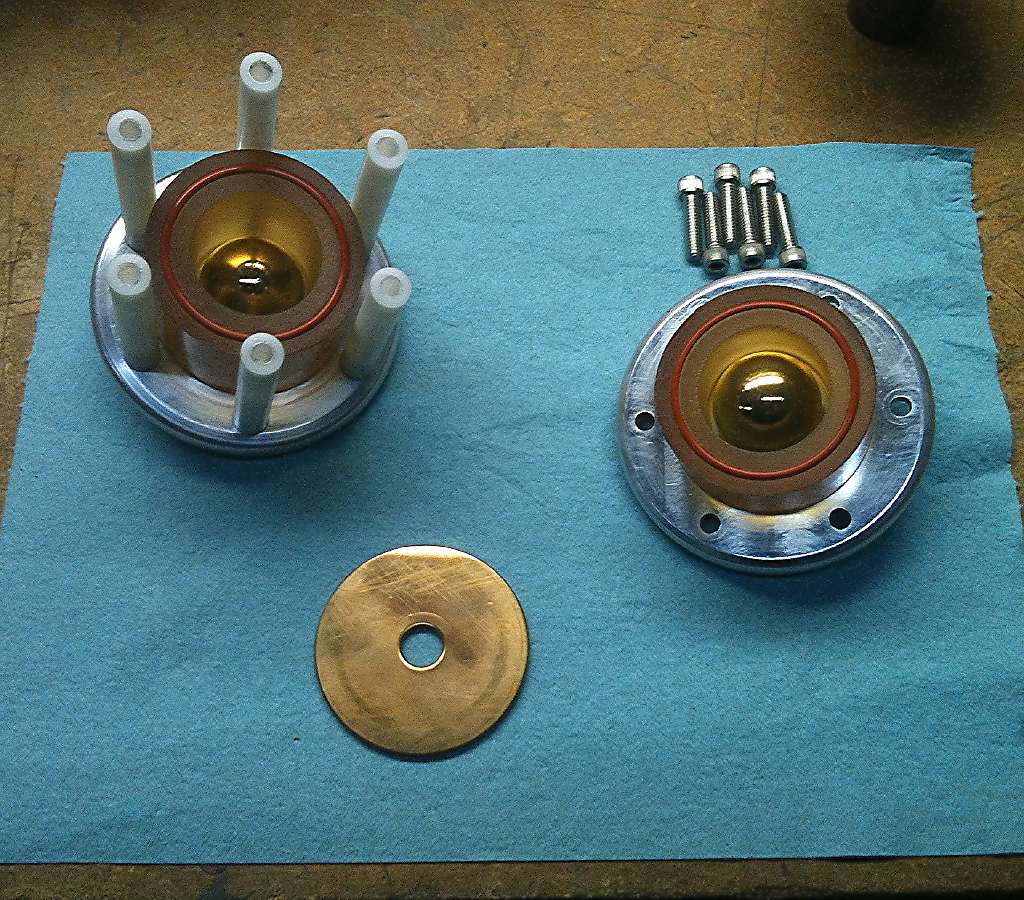
My Triggered Spark Gap Switch requires some rework before I strap it to one of the 3kJ pulse caps and a pulse resistor and transfer a 1 kA / 1MW pulse through it.

It turns out I can do at least part of said re-work without spending money. I just need to get a different project off of the lathe so I can work on the trigger plane electrode. Two things need doing:

Thing One
I'll be making the ID about twice as large, all the better to pass a large diffuse plasma discharge, my dear, preferably without actually involving the trigger electrode - remember, this is a field-distortion switch, we hope)

-and-

Thing Two
I'll be removing the radius on the ID, leaving instead an acute angle with a sharp edge. This angle will be tapered on the large-gap side and in-plane on the small-gap side. The better to distort the field with, my dear. However, a sharp-edged trigger plane must be PREZACKLY biased with respect to the ratio of the two gap distances. I have the vague recollection that the ratio of diameter to main electrode distance was to be in the range of 1.0 - 1.6, but my memory is notoriously unreliable, so we'll just leave that a hypothetical until I find the collection of photons and spins states that constitutes a "white paper" these days...

Looky here:

switch tear-down.jpg


That brass disk with the hole in it, bottom-center, is the trigger plane electrode. The hole in the middle needs to be about twice as big or a bit bigger. Someone mentioned (in some switch white paper I have somewhere) an empirically-arrived-at rule of thumb for main electrode distance vs. hole size for this style of switch, but finding it again will take some time...

As is probably obvious, this switch has not had a single shot through it. I realized after I finished it that the changes were needed. Just now got around to diddling with it in between thirteen other things.

I lied unintentionally: THREE things need doing. A second set of holes in each switch end plate needs to be made, identical to the ones that are there now, but countersunk in the opposite direction, for bolting the switch into a transmission line or to coaxial test loads. Having a bolt circle lets me fashion large-diameter connections and current paths which translate in the general case to low distributed inductance, which informs the minimum attainable pulse rise time. Readers who have read my earlier descriptive material here and on Flickr will have gleaned that a big part of what I am hoping to do with this switch is not merely transfer big lumps of energy around, but to achieve very fast switching speeds and commutation times -- fast, that is, for a rank amateur with not formal schooling in pulsed power!

Oh yes, I will be studying calculus in 2012, or that's the plan anyway.

I'm just not in any shape to finish the project currently occupying the lathe and which I don't want to re-center later. Humph. But I am not idle. I'll get some of the above done soonish I think. Things ought to be a LOT better in 2012 than they have in a very long time.

Stay tuned.

Tuesday, October 11, 2011

even yet more further additional progress on my "Last Tesla Coil", book two, part twelve, chapter 27...

laceration engine.jpg

You might think this is the nearly-finished primary of a Tesla coil. And you would be reasonable to think so. But you would be mistaken. This is a laceration engine.

Well, I couldn't wear gloves because I needed the dexterity and the clearance between turns. I tried. I tried rubber gloves, but they didn't protect, just as I'd expected.

After I get done putting Band-Aids™ on all my fingertips, I'll have one more go at straightening and evening-up the turns, leaving them a bit tighter (to keep them from shifting -- as much), which is to say less of a perfect spiral, and more of an octagon. Then I will cut the outer end to its final length and screw it down. Wee! All this should be done a few hours after this post goes up.

It will be badly tempting to lash up a primary circuit for it just so I can try it out, but although I have most of the parts, nothing is put together. Also, I don't have quite enough capacitance, methinks. Gotta go through the calcs one more time after I measure the as-built primary inductance and plug it into the formulae. Furthermore, the HV transformer for this coil is practically unreplaceable, and I'll be damned if I will blow it up, which means I really need to finish the "Terry Filter" for it before running it. *sigh* Did I ever mention this? This coil will be fed by DC, so no resonant charging. I wish to be very kind to my precious 120mA NST, and I am effectively isolating it from the primary circuit entirely.


I wish there was a way to make that primary stay this pretty pink color forever, but there isn't. If I spray it with acrylic now, the acrylic will get all over the finished wood and mess up its finish. It wasn't practical to spray it before installing it - I thought about it for all of ten seconds. There's over 90 feet of 1" copper strip here, so I'm not gonna be dabbing Futura on it with a cotton swab, or laying it out on the sidewalk to spray it.

I'll spray or coat (Futura floor wax also works great) all the brass. That'll have to be enough shiny. The copper will all be dull brown in ten years.

I'll take a "glamor shot" of the complete Tesla coil primary and secondary -- minus one minor dodge I have to add to the strike rail -- later tonight.

Okay, it's later: MLTC milestone.jpg


Inquiring minds will want to know what else needs to be finished before it runs. Here's a laundry list:

* primary capacitor - this will be an MMC of course, the most reliable sort there is. I have most of the caps for this, bought as a "finished" (bleh) MMC, but I am not comfortable with the number of caps in each string (determines the maximum safe operating voltage of the complete array) so I will need to add a cap or two to each string. Since that lowers the capacitance of each string I'll need to buy enough additional caps to add another string or two as well. The cap will be built with brass "strapping" terminals mounted on the exterior so that any number of strings may be placed in or out of circuit.

* spark gaps - I have one spark gap completed, but intend to build at least two more. The finished one is the "sucker gap" previously about posted here. I've got a disk, hub, and shaft done for an asynchronous rotary. I've got all the electrodes made, but not yet drilled, for a Richard Quick style gap. I've made nothing else nor thought about the housing for that. I'd kinda like to make a gap like one that Old Nik' was known to have used in his original NYC lab before it burned to the ground. It was just a bunch of brass balls in series. Not the best performing gap, but if memory serves, that was long before he'd invented several new kinds of fast-quenching gap switches.

* control panel - again, I've got most of the expensive parts for this, but there's a lot of finicky work to be done on said parts. I'll need to make new cards for the meters. I'll need to obtain a few specialty parts like a current transformer. The HV transformer is HEAVY so I'm considering building a cart for the control panel rack cabinet (which will be heavy enough without the transformer in it) and possibly putting the transformer in the cart/base. I might leave it in the panel cabinet and use the cart/base for storage of cables and parts. I haven't thought very much about that. And there's surely a ton of small parts I don't have, like controls. Much work to be done there.

* the damned primary tap connectors. These are gonna be finicky to make, but a joy to have and use versus any other primary tap method I've ever seen used by anyone, anywhere. So there. Okay look, that crazy rotating thing with the sliding brushes doesn't count - that's not "tapping". Yeah. So anyway, I think I've got the design worked out. I haven't started collecting various red metals (copper, brass, bronze) yet. And I have to make two of them. Bleh.

* cabling & miscellanea - the ground connections, a ground rod kit with straps, the umbilical between control panel and coil, to name a few examples.

So there is still a long, long way to go before we see first light on this beast.

PS: I noticed just now that pictures in some of my older posts are missing. I'll look into this in a bit. Probably nobody but me noticed anyway.